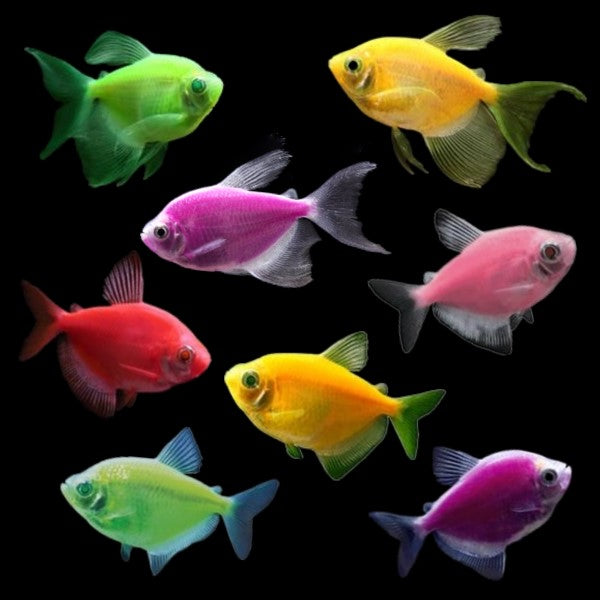
MP | Glofish Tetras


From https:glofish®.com
 
Species Name: Glofish Tetra (Gymnocorymbus ternetzi) 
 
Description: 
GloFish Tetras are a genetically modified variation of the common Tetra fish (usually the Black Skirt Tetra or White Skirt Tetra) that exhibit vibrant fluorescent colors. These colors are a result of a naturally occurring fluorescence gene found in certain species of jellyfish, corals, and other marine organisms, which has been inserted into the tetra's DNA. GloFish Tetras are available in various colors such as Starfire Red, Sunburst Orange, Moonrise Pink, Electric Green, Cosmic Blue, and Galactic Purple, making them highly attractive and popular in the aquarium trade.
 
Habitat: 
GloFish Tetras, like their non-genetically modified counterparts, are native to South America, primarily found in the Amazon River Basin and its tributaries. They prefer slow-moving waters with dense vegetation and subdued lighting.
 
Behavior: 
GloFish Tetras are social and schooling fish, meaning they thrive in groups. They are generally peaceful and can coexist with other non-aggressive fish species. Their schooling behavior provides them with security and reduces stress, making them a great addition to community aquariums.
 
Diet: 
These tetras are omnivorous, feeding on small insects, crustaceans, and plants in the wild. In captivity, they can be fed high-quality flake or pellet food. Additionally, they enjoy live or frozen foods like brine shrimp and blood worms, which help enhance their colors.
 
Care Requirements: 
GloFish Tetras require a well-planted aquarium with plenty of hiding spots and subdued lighting to minimize stress. They thrive in slightly acidic to neutral water conditions with stable parameters. Regular water changes are essential to maintain their health and vibrant colors. It's important to provide them with a balanced diet and ensure they are kept in suitable tank mates to prevent stress-related illnesses.
 
Interesting Fact: 
GloFish Tetras are not found in the wild; they are exclusively bred for the aquarium trade. Their fluorescent colors are a result of genetic modification, allowing them to fluoresce under certain lighting conditions, creating a captivating visual display in aquariums.

Please note that the genetic modification of animals for ornamental purposes raises ethical concerns, and it's important for aquarists to be aware of the origins and ethical implications of the fish they choose for their aquariums.

 
OpenAI. (2023, October 12). Glofish Tetra: Species Profile.


Comments

Popular posts from this blog

DIY - How to Make a Glass Aquarium

Hello everyone! In this blog post we will walk you through the basic steps on how to make a glass aquarium (we will be making two 15gallon tanks with dimension 24" x 12" x 12") plus we will also be teaching you a quick, cheap, easy & hassle-free way to make a background for your tank, What you will need: Materials: Glass, Silicon tube, Masking tape, Styrofoam board, Charol plastic sheet, Shampoo (any brand), Newspapers Tools: Caulking gun, Cutter knife, Scissors, Plastic card Purchasing the glass First of all, you'll need to go to your local aluminum & glass supply shop and purchase the glass you will need for your project. Use the chart below to determine the standard dimensions of the tank you want to make (forgot the source of the chart so if you guys know kindly post it on the comments section).     Making the Tank Now that we have our glass, time to get out the caulking gun and silicon tube so we can start assembling our glass...

Daphnia Magna Culture

     I received the daphnia magna culture I ordered last Saturday from a great and reliable source and had a 10 gallon tank setup to try my luck in culturing these interesting critters. The culture tank has an air hose with low aeration and I even placed an aquarium thermometer to keep an eye on the water temperature of the tank. Aged pond water from my outdoor koi pond is being used as the daphnia magna culture water. I’m feeding them yeast dissolved in aged water and so far they are doing fine. It is their 4th day today and I can already observe that their numbers are multiplying, an opposite of what I got when I was trying to culture Daphnia Moina, a much smaller version of Daphnia Magna.      A problem that I currently have with my setup is that the temperature of the tank water is high compared to the recommended 65 – 70 °F. Hoping that I could somehow find a way around this. Suggestions will be highly appreciated. You can ...

LED lightbulbs for aquarium lighting

A few weeks ago we decided to use LED lighting on the new tank racks we had instead of using tubular fluorescent lighting. We used Unitech LED lightbulbs as they were pretty cheap and the cover was made out of plastic and is easily removed. Just a quick twist and it pops off easily. No need to damage the lightbulb and if you want to, you can just plop the cover back in. With cover Without cover Installed it to the middle rack in parallel connection with all the lights connected to one switch. Flipped on the switch and all the LED lightbulb burst to life. Been observing the lightbulbs for some time and so far the performance is good. Used to have 12-24watts of lighting per 15gallon tank but now with these energy efficient LED, its down to 3-5watts per tank. By removing the cover of the bulb it greatly reduces the glare and gives a kind of spotlight effect making it unnecessary to install hoods or reflectors. The manufacturer claims that the light produced by ...